
Research in the Museum Collections
Most of the museum objects can be found in the Estonian Museums Public Portal (MuIS). Select “Detailed Search” (Detailne otsing) and “Viljandi Muuseum”, as shown in the screenshot below.
Searches should primarily be carried out using the first field, “Object Name” (Nimetus). To find different word endings and compound words, enter part of a word between percentage signs (%). For example, use %raudtee% to search for railway-related images or %raeko% to find material relating to the town hall. Selecting “Objects with Images” (Pildiga museaalid) limits the results to records that include an image.
To select the museum, enter the abbreviation VM in the first field (ACR).
To search within a specific collection, enter its collection code (KT) in the sixth field. The collections and their codes are listed below. Please note that uppercase letters in the collection codes must be entered exactly as shown.
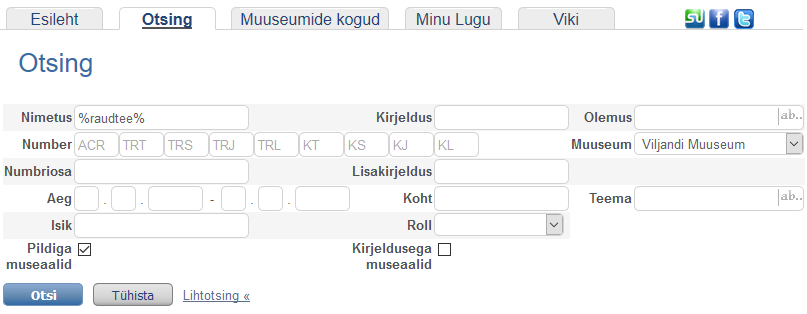
Detailed search in MuIS

Example of a search in the Viljandi Museum photographic collection
History Collection (Aj) contains approximately 3,200 objects, including a wide variety of everyday and decorative items, as well as furniture.
The Phaleristics Collection (N-2), a subcollection of the History Collection, contains approximately 600 objects related to orders, decorations and awards.Archaeological Collection (A) comprises nearly 60,000 objects. The collection originated from finds recovered during archaeological excavations at Viljandi Castle in 1878–1879. Among its most notable holdings is a collection of carved architectural stone fragments from the castle.
Archive Collection (Ar) contains nearly 17,300 archival items, including documents, manuscripts, plans, drawings, posters and labels.
Ethnographic Collection (E) comprises more than 4,600 objects. The collection is broadly divided into textiles (including jewellery) and wooden objects (including metal objects).
Photographic Collection (F) contains nearly 20,000 photographs, postcards, negatives and other photographic materials. A significant proportion consists of views of the town of Viljandi, many of which were produced in the studio of Jaan Riet, Viljandi’s best-known photographer.
Art Collection (K) comprises more than 3,100 works by approximately 100 artists. The collection primarily focuses on works by artists associated with Viljandi.
Natural History Collection is divided into three subcollections: Geology (G), Botany (B) and Zoology (Z). Together, they contain nearly 3,500 specimens.
Library consists of a scholarly reference library and a book collection forming part of the museum’s main collection (R-3). Together, these holdings comprise more than 30,000 printed publications.
For further information, please contact the curators responsible for the respective collections (see Contact Information).
Requests to study museum objects on site may also be submitted by email to info@viljandimuuseum.ee or through the feedback form associated with the relevant object in MuIS.
In early 2026, access to the research room is available by prior appointment only.
→ Principles for the Development and Use of the Collections of Viljandi Museum Foundation, 2025–2030 (PDF) (in Estonian)
Digital images of works in the museum’s collections that are no longer protected by copyright (marked “Public Domain” in MuIS) may be used free of charge for both personal and commercial purposes. Such works are in the public domain.
Copyright status may not yet have been determined in MuIS. However, works generally enter the public domain 70 years after the death of their author.
Examples include works by photographers Jaan Kristin (also known as Christin), Jaan Riet and Tõnis Parr.
If a digital image of sufficient quality is not available, the museum may charge a fee to cover digitisation and administrative costs, even for works in the public domain. See also the Services page.
Where a work remains protected by copyright, permission to reproduce it must be obtained from the author or their heirs.